
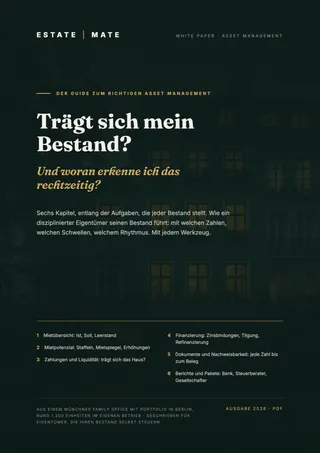

Every owner asks this question, most of them at night: does my portfolio pay for itself? And how do I see it in time? A glance at the account balance will not answer it. The balance knows nothing of the insurance bill arriving in November, the stepped rent nobody ever invoked, or the loan whose fixed-interest period ends in eighteen months.
Whoever runs a property portfolio runs a business, even one that grew on the side: first two buildings, then five, then ten. The tools rarely grow with it. The rent roll lives in Excel, the contracts in the basement, the loans in the bank’s filing.
That is the normal state of a small-scale industry: 91.89 percent of real estate companies have fewer than ten employees (ZIA, 2024). There is no back office to impose order. And only 24 percent of companies in the industry use the data they already have for analysis to any meaningful extent (Drees & Sommer, 2025). For the rest, the answers sit in the portfolio, but nobody reads them.
One clarification up front: this is not about property management. The day-to-day, collecting rents, settling service charges, hiring tradespeople, sits with your property manager, and that is where it belongs. Asset management is the level above, and nobody takes it off your hands: setting targets and thresholds, steering and controlling the manager, reading target against actual, deciding.
Six fields of control turn that level into a method. Each works on its own; together they produce what a bank, a tax advisor or your own family recognises as a managed portfolio.
1. Rent overview: actual, target, vacancy
The rent roll is the foundational document of the portfolio. Every owner believes they have one, until someone asks for it who makes decisions based on it. The single most important rule: a rent roll is a point-in-time document.
The bank does not ask for “the rent roll”; it asks for the rent roll as at 31 December. And again next year.
The second rule: actual and target are two columns. Wherever they diverge, there is either an arrear or a forgotten increase. Both belong in plain sight.
2. Rent potential: the quiet erosion
No line item in a portfolio disappears as quietly as the increase nobody invokes: the stepped rent that never gets its letter, the index-linked rent whose base index nobody remembers. None of it hurts, none of it stands out. It is simply missing every month, and it compounds, because every missed increase is also the base of the next one. The standard against it: potential is a number per unit, in euros per month. And the tool is four paragraphs of statute and a calendar, no law degree required.
3. Payments and liquidity: the actual arithmetic
“Does my portfolio pay for itself?” sounds like strategy but is arithmetic, provided you run it per property and in the right order: from actual rent collected, subtract the non-recoverable operating costs, which yields net operating income. From that, subtract debt service, which yields the liquidity result. If it is negative, the building does not pay for itself, however good the account balance feels right now.
One precision that gets expensive when missing: before or after amortisation. A property that only pays for itself before amortisation is building wealth at the expense of liquidity. That can be a deliberate decision. It just must not be an unnoticed one.
4. Financing: few dates, much money
No part of the portfolio moves as much money with as few dates as the financing. Every fixed-interest expiry has turned from an administrative event into an economic crossroads: owners who know their schedule negotiate; owners who don’t, sign. Three tools belong here: a loan register with outstanding balances as at a fixed date, a fixed-interest calendar across the whole portfolio, and an annual stress test of whether the rents still carry the follow-on instalment at plus two percentage points.
5. Documents: every figure down to its source
Everything above stands or falls with an unassuming question: can you prove it? A figure that cannot be traced back to its document in under a minute is a claim. Banks, tax advisors, buyers and courts treat it accordingly. The standard starts unspectacularly: one document, one place, one version, the same folder skeleton for every property.
6. Reports: sendable without embarrassment
In the end, the fields converge in what others see of your portfolio: the report to the bank, the package for the tax advisor, the overview for the family or the shareholders. In a managed portfolio, these documents materialise on request. Three days and four emails mean the opposite.
How much of this is a question of tooling?
Honestly: less than the industry claims, and more than one hopes. Much of it you can achieve with paper, Excel and discipline. Our white paper “Is my portfolio paying its way?” describes the practice standard for each of the six fields, independent of any tool: which numbers, which thresholds, which rhythm, each chapter with a checklist to work through and a short self-diagnosis. At every point it says honestly how much discipline that is, and where Excel ends. The paper is currently available in German.